Paylaşılan kitaplardan anında haberdar olmak için kanallarımızı takip edebilirsiniz:

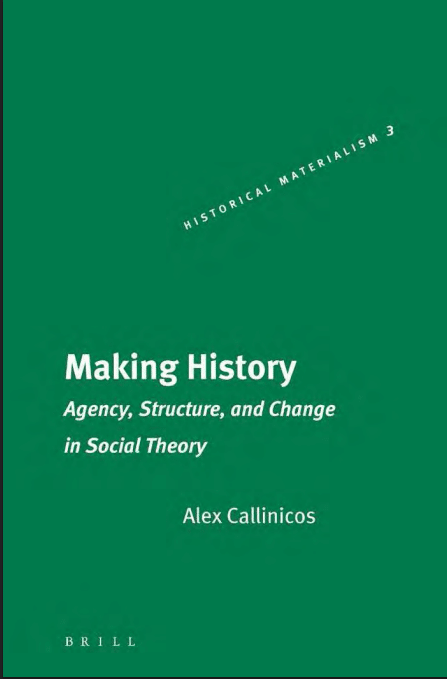
Making History: Agency, Structure and Change in Social Theory PDF
İndirme: 8
PDF Book Information
Book Title: Making History: Agency, Structure and Change in Social Theory
Author: Alex Callinicos
Category: Sociology / Social Theory
Language: English
File Type: PDF
Telegram : https://t.me/birkitap1
Book Description
Making History: Agency, Structure and Change in Social Theory by Alex Callinicos is a rigorous and insightful work in social theory that explores some of the most central issues in understanding how societies change over time. This book addresses one of the core problems in sociological thought: how to reconcile human agency (the capacity of individuals to act independently and make choices) with social structure (the patterned social arrangements that constrain and enable human behavior).
Callinicos argues that neither agency nor structure alone can provide a full explanation of social change — they must be analyzed together. Drawing on a wide range of theorists, from Karl Marx and Max Weber to contemporary critical theorists, the book offers a historical and philosophical grounding for a genuinely dialectical approach to social inquiry. Rather than treating agency and structure as separate or opposing forces, Callinicos shows how they are interlinked and how their interaction produces historical transformation.
The book is known for its clear yet scholarly style, making complex theoretical debates accessible without oversimplifying. It provides a critical examination of competing sociological paradigms — including structuralism, postmodernism, and functionalism — and offers a compelling alternative grounded in critical realist philosophy and Marxist social theory. The result is a work that not only explains major theoretical positions but also equips the reader to evaluate and apply them in empirical research.
Making History is an essential read for sociology students, social theorists, and anyone interested in understanding how historical processes are shaped by both human action and structural constraint.
Book Summary (Contains spoilers)
The book opens by framing the agency–structure debate as a fundamental question in social theory. Callinicos critiques simplistic models which assume that either individuals are completely free agents or that they are entirely shaped by social systems. Instead, he proposes that social life is best understood through a relational ontology: structures influence human action, but human actions also reproduce or transform social structures.
In the early chapters, Callinicos explores classical sociologists such as Marx, Weber, and Durkheim. Marx is highlighted for his emphasis on historical transformation emerging from class struggle and material conditions — a perspective that emphasizes structure but does not render agency irrelevant. Weber’s focus on individual motives and rationality, by contrast, foregrounds agency but struggles to explain broad social patterns. Durkheim’s structural approach provides insights into social cohesion but is critiqued for underplaying human agency.
The middle sections of the book move into 20th-century social theory, examining how structuralism and postmodernism have attempted to rethink the agency–structure problem. Structuralism (influenced by thinkers such as Lévi-Strauss and Foucault) is critiqued for its tendency to reduce individuals to products of deep structures, while postmodernism is examined for its skepticism toward grand narratives and universal explanations. Callinicos argues that both fail to adequately account for how real historical change occurs.
Building on critical realism, a philosophical approach that insists on the reality of social structures while recognizing human agency, Callinicos develops a model of social change that sees individuals as capable actors embedded in structural contexts. He discusses how social movements, class struggles, and collective action illustrate the dynamic interplay between agency and structure. These cases show that social change is not merely the unfolding of structural imperatives nor the product of autonomous individual choices, but the result of ongoing interactions between actors situated within material and institutional constraints.
In the final chapters, the book synthesizes its arguments into a coherent framework for understanding history as both contingent and structured. Callinicos underscores that neither social structures nor human agents alone determine historical outcomes, but that historical transformation arises from their complex and mutual influence.
Why You Should Read This Book
- To understand the agency–structure problem, one of sociology’s central debates
- To gain a historical and philosophical grounding in major social theories
- To critically engage with Marxist, Weberian, structuralist, and postmodern perspectives
- To explore how individuals and structures shape historical change together
- For clear explanations of complex theoretical debates in sociology
Reader Impressions
- “A comprehensive and critically sharp account of social theory.”
- “Callinicos brings clarity to a notoriously difficult debate.”
- “Useful for both students new to theory and long-time scholars.”
- “The relational approach to agency and structure is compelling.”
- “Grounded in real theoretical traditions, not vague abstractions.”
- “Well balanced between classical and contemporary theory.”
- “Essential for anyone studying sociology or history of ideas.”
FAQ
Q: Is this book suitable for beginners?
A: It assumes some familiarity with social theory, but Callinicos’s clear style makes it accessible to motivated learners.
Q: Is it more philosophical or empirical?
A: It is primarily a theoretical and philosophical work, though it engages with empirical implications.
Q: Does it focus on Marxism only?
A: No — while rooted in critical social theory, it critically engages multiple traditions.
Q: Does it include historical examples?
A: Yes, illustrative examples are used to illuminate abstract arguments.
Q: Is prior sociology study necessary?
A: Helpful but not strictly required; foundational chapters help build understanding.
Q: Does the book propose a single model of social change?
A: It proposes a framework emphasizing dialectical interaction between agency and structure.
Q: Is the PDF format readable on all devices?
Yes, the PDF is compatible with phones, tablets, and computers.
Making History: Agency, Structure and Change in Social Theory PDF Download Link
This book is available as a PDF and can be read comfortably on digital devices.
Kitabı Hemen Okumaya Başla
PDF yükleniyor...