Follow our Telegram channel to get notified instantly whenever new books are published.

English for Presentations PDF – Adrian Wallwork
Total Downloads:
6
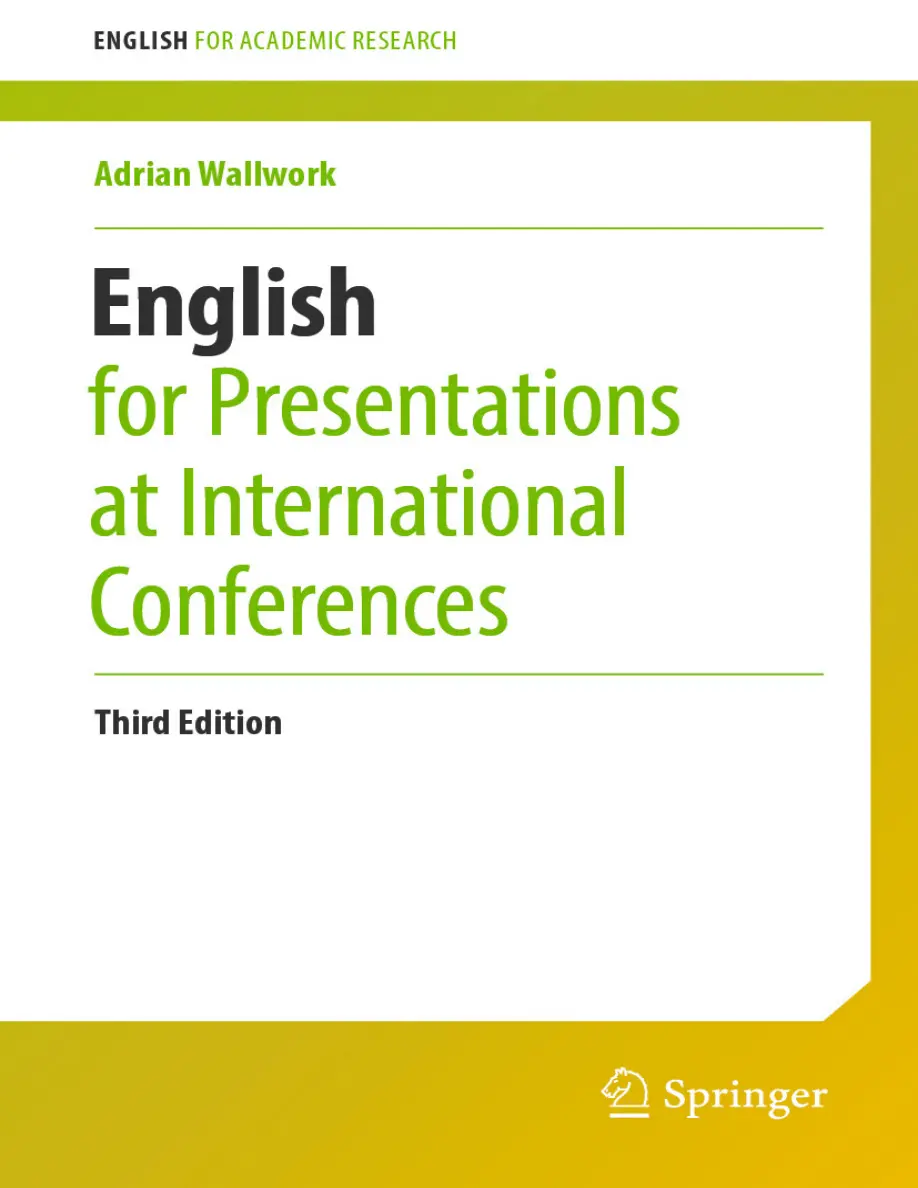
English for Presentations Book Summary & Review
Quick Summary
A practical linguistic handbook helping non-native speakers design, phrase, and deliver high-impact professional presentations.
Book Topic and Premise
Why do highly competent international professionals often struggle to engage audiences during overseas conferences? In English for Presentations, veteran ESL instructor Adrian Wallwork addresses this widespread professional barrier by delivering a targeted, phrase-by-phrase linguistic toolkit. The book shifts focus away from abstract grammar rules to concentrate purely on the mechanics of impactful public speaking.
The chapters follow the chronological timeline of a corporate or academic speech. The author details how to hook an audience in the opening seconds, transition smoothly between complex slides, and handle difficult post-presentation question panels. The text systematically highlights the major cultural and linguistic differences that cause non-native speakers to sound monotone or confusing.
Professionals reading the PDF version will find immediate utility in the extensive tables of pre-packaged transition phrases. The textbook provides specific strategies for simplifying dense text and presenting statistical data clearly. This reading material builds immediate confidence, allowing users to eliminate robotic reading behavior from their communication repertoire.
Ultimately, Wallwork provides an empowering professional asset that directly impacts global career advancement. The focus remains entirely on clarity, economy of language, and audience connection. It remains a vital reference manual for anyone navigating the international conference circuit.
Detailed Plot & Summary
This instructional manual breaks down every phase of public speaking for ESL professionals, offering specific templates for introductions, slide transitions, data descriptions, Q&A management, and audience engagement.
✍️ Editor’s Note: An invaluable corporate asset for international business executives and academics presenting research globally.
Critical Review and Analysis
Wallwork provides exceptional, realistic examples of common phrasing mistakes that kill audience engagement. However, advanced native speakers might find the grammatical structures and vocabulary templates too elementary for high-level academic defense.
Main Themes & Motifs
- Cross-Cultural Communication
- Linguistic Clarity
- Audience Engagement
- Structural Confidence
Who Should Read This Book?
Non-native English speakers, international corporate professionals, academic researchers, and graduate students preparing for thesis defenses.
Why You Should Read It
It provides hundreds of instantly usable phrases that eliminate hesitation and filler words during high-pressure speeches.
Key Takeaways & What You Will Learn
How to structure an intro, describe complex charts fluidly, handle aggressive audience questions, and pace delivery for maximum comprehension.
Technical & Bibliographic Details
| 📖 Title: | English for Presentations |
| 🔍 Original Title: | English for Presentations, 3rd Edition |
| ✍️ Author: | Adrian Wallwork |
| 🗣️ Translator: | N/A |
| 🏢 Publisher: | Springer |
| 📅 Publication Year: | 2014 |
| ⏳ First Published: | 2010 |
| 🔢 ISBN: | 9781493906437 |
| 📦 Amazon ASIN: | 149390643X |
| 📄 Total Pages: | 190 |
| 📁 Category: | Linguistics, Business Communication, Language Reference, ESL, English |
| 🌍 Language: | English |
| ⭐ Goodreads Rating: | 4.15 / 5.0 (52 votes) |
| ⏱️ Reading Time: | 4 hours |
| 📊 Difficulty Level: | Easy to Intermediate |
| ⛓️ Book Series: | English for Academic Research (Vol. ) |
| 📚 Similar Books: | Presentation Zen, Talk Like TED |
| ✍️ Other Books by Author: | English for Academic Correspondence, English for Writing Research Papers |
Frequently Asked Questions (FAQ)
❓ Is this book intended for native English speakers?
While native speakers can benefit from the structural advice, the book is specifically engineered to resolve the unique challenges faced by ESL/EFL presenters.
❓ Does Wallwork include visual presentation design advice?
Yes, it features concise chapters detailing how to format PowerPoint or Keynote slides to complement, rather than distract from, spoken English.
❓ Are there audio components included in the text?
This printed/digital text focuses on written scripts and phonetic phrasing tips rather than independent audio file attachments.
❓ Can this help me prepare for an academic thesis defense?
Absolutely. The book contains explicit strategies for presenting complex data and defending arguments before academic panels.
❓ How are the phrase banks organized inside the book?
Phrases are grouped logically by function, such as ‘introducing a new topic,’ ‘summarizing data,’ or ‘concluding a segment.’
❓ Does the text address how to manage public speaking anxiety?
Yes, it provides practical psychological strategies focused on linguistic preparation to significantly reduce stage fright.
📚 Recommended Category: Explore more in our Linguistics hub.