Follow our Telegram channel to get notified instantly whenever new books are published.

Large Language Model Recipes PDF – Bharath Kumar Bolla
Total Downloads:
2
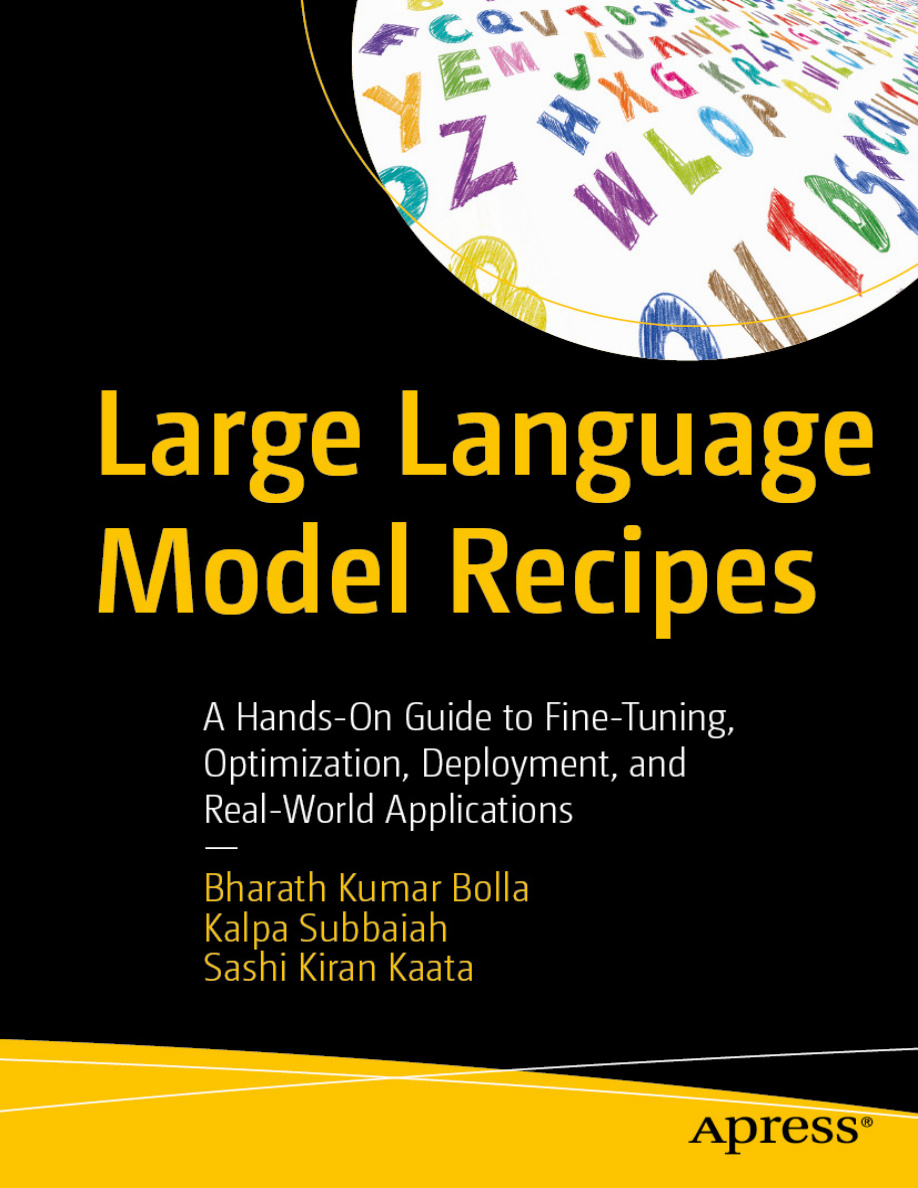
Large Language Model Recipes Book Summary & Review
Quick Summary
A practical cookbook containing Python recipes for fine-tuning, deploying, and building applications with LLMs.
Book Topic and Premise
Navigating the rapidly shifting landscape of artificial intelligence requires practical, reproducible code patterns. In Large Language Model Recipes, AI practitioner Bharath Kumar Bolla delivers a hands-on technical cookbook designed for developers and data scientists. The book focuses on real-world engineering solutions rather than purely theoretical machine learning concepts.
From fine-tuning open-source models like Llama with PEFT and LoRA to architecting robust Retrieval-Augmented Generation (RAG) pipelines using LangChain and vector databases, Bolla covers the end-to-end LLM lifecycle. Engineers reading this PDF version will find clean Python implementations for prompt optimization, guardrails, model quantization, and API integration. Each recipe clearly outlines the problem, technical implementation, and architectural considerations.
This guide serves as a practical blueprint for deploying scalable AI applications. Bolla addresses common production hurdles such as reducing latency, managing API costs, and evaluating model outputs objectively. Anyone who takes the time to read Large Language Model Recipes will gain immediate, applicable skills for building modern AI applications.
Detailed Plot & Summary
Bharath Kumar Bolla provides actionable, code-first solutions for working with Large Language Models. Covering RAG architectures, prompt engineering, LoRA fine-tuning, vector databases, and model deployment, this guide equips developers to build real-world AI software.
✍️ Editor’s Note: A must-have developer guide for engineers building production-ready RAG applications and LLM workflows.
Critical Review and Analysis
An exceptionally practical resource for AI developers. Bolla skips unnecessary fluff to deliver clean, runnable Python code examples. Keep in mind that rapid LLM library updates mean some dependencies require checking latest documentation.
Main Themes & Motifs
- LLM Fine-Tuning
- RAG Systems
- Prompt Engineering
- AI Application Deployment
Who Should Read This Book?
Python developers, machine learning engineers, data scientists, and software architects building AI-powered applications.
Why You Should Read It
It supplies copy-paste ready Python recipes for building, optimizing, and deploying production-grade LLM systems.
Key Takeaways & What You Will Learn
How to set up RAG pipelines, fine-tune open-source models with LoRA, utilize vector databases, and implement guardrails.
Technical & Bibliographic Details
| 📖 Title: | Large Language Model Recipes |
| 🔍 Original Title: | Large Language Model Recipes |
| ✍️ Author: | Bharath Kumar Bolla |
| 🏢 Publisher: | Packt Publishing |
| 📅 Publication Year: | 2024 |
| ⏳ First Published: | 2024 |
| 🔢 ISBN: | 9781835088234 |
| 📦 Amazon ASIN: | 1835088231 |
| 📄 Total Pages: | 340 |
| 📁 Category: | Computer Science, Artificial Intelligence, Packt Publishing, English |
| 🌍 Language: | English |
| ⭐ Goodreads Rating: | 4.35 / 5.0 (42 votes) |
| ⏱️ Reading Time: | 8-10 hours (hands-on code execution) |
| 📊 Difficulty Level: | Hard (Technical/Coding) |
| 📚 Similar Books: | Building LLM Powered Applications by Valentina Alto, Natural Language Processing with Transformers by Lewis et al. |
Frequently Asked Questions (FAQ)
❓ What programming language is used in Large Language Model Recipes?
All code examples and recipes in the book are written in Python utilizing popular AI libraries.
❓ Does the book cover Retrieval-Augmented Generation (RAG)?
Yes, several detailed recipes cover building, evaluating, and optimizing RAG pipelines using vector storage.
❓ Is prior machine learning knowledge required to follow this book?
A solid background in Python programming and basic machine learning concepts is recommended to get maximum value.
❓ Does Bharath Kumar Bolla discuss fine-tuning open-source LLMs?
Yes, recipes include parameter-efficient fine-tuning techniques such as LoRA and QLoRA on custom datasets.
❓ Are the PDF code snippets easy to copy and run locally?
Yes, code blocks are formatted for easy copy-pasting into Jupyter Notebooks or Python IDE environments.
❓ Does the book address model security and guardrails?
Yes, recipes cover prompt injection defense, output filtering, and implementing guardrails for safe AI deployment.
📚 Recommended Category: Explore more in our Computer Science hub.