Follow our Telegram channel to get notified instantly whenever new books are published.

Geodynamics and Earth Tides Observations PDF – Braitenberg
Total Downloads:
2
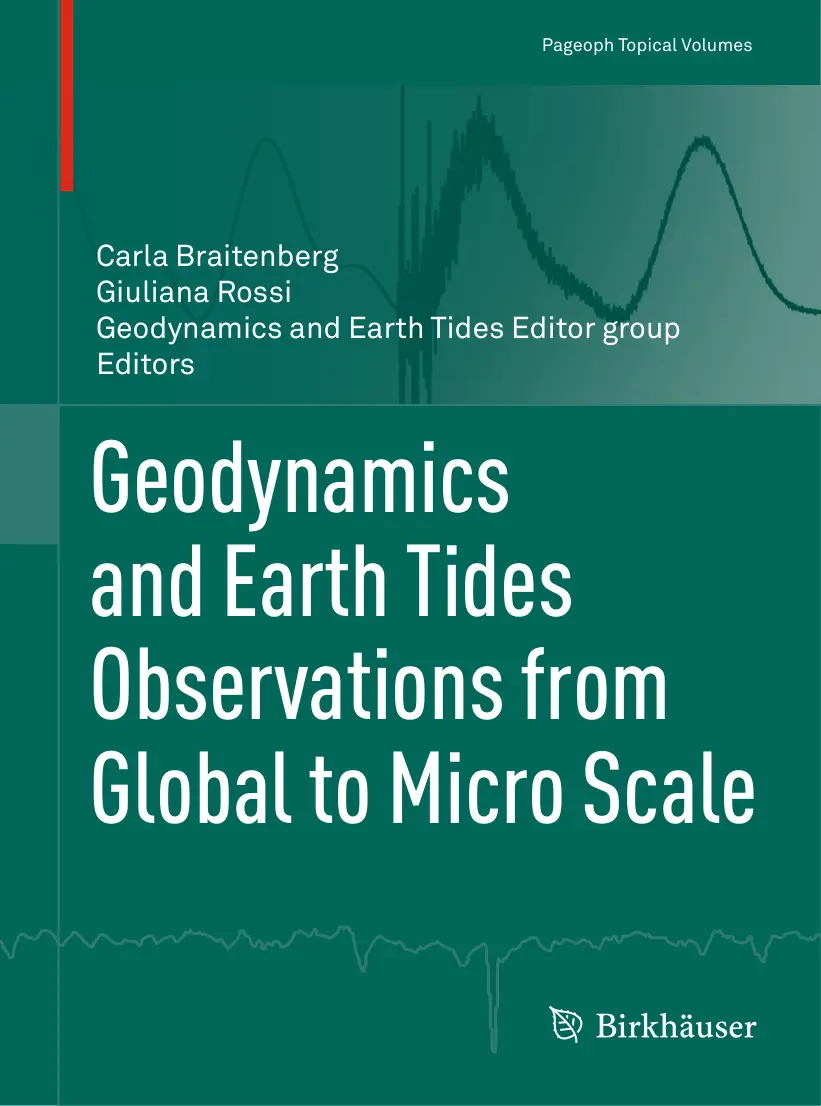
Geodynamics and Earth Tides Observations Book Summary & Review
Quick Summary
A highly specialized geophysical manual analyzing the mathematical formulas, observation methods, and instrumentation patterns used to map solid Earth tides and crustal strain.
Book Topic and Premise
How do the overlapping gravitational attractions of the moon and sun physically deform the solid rock crust of our planet every single day? In Geodynamics and Earth Tides Observations, leading geophysicist Dr. Carla Braitenberg provides a comprehensive, mathematically rigorous manual detailing the collection and parsing of macro-gravimetric data. The textbook moves past basic geological maps to analyze the active elasticity of the lithosphere.
Studying the intricate geophysical equations within this PDF version, earth science candidates master the mechanics of crustal deformation tracking. Carla Braitenberg coordinates her research documentation around precise instrument calibration, demonstrating how superconducting gravimeters can detect micro-gal changes in localized gravity fields. The prose style is precise, highly technical, and strictly data-oriented, evaluating the filtering of ambient barometric noise from long-term tiltmeter records.
This Springer publication stands out because it directly links solid earth tide observations with the prediction modeling of active tectonic fault zones. The text details how tidal stress loads can act as periodic triggers for localized seismic events in highly stressed continental plates. Reading this advanced handbook equips geophysical engineers with the structural frameworks required to manage satellite geodetic data pools accurately. It remains an essential reference document designed to safeguard the precision of global tectonic monitoring arrays.
Detailed Plot & Summary
Dr. Braitenberg breaks down the mechanics behind solid Earth deformations caused by lunar and solar gravitational fields. The text evaluates advanced tiltmeter instrumentation, superconducting gravimeters, satellite geodetic data, and structural strain changes, linking tide observations with active earthquake fault monitoring and lithospheric stress patterns.
✍️ Editor’s Note: The benchmark reference manual for contemporary gravimetric and tidal deformation research. It bridges the gap between planetary astronomical mechanics and micro-tectonic stress tracking.
Critical Review and Analysis
Braitenberg provides an exceptionally thorough, data-heavy guide that researchers in seismology will find indispensable. Her technical chapters explaining tiltmeter calibration are stellar. However, this is an advanced geophysics research manual; general geology hobbyists will find the dense matrix algebra, fluid dynamic models, and wave-filtering equations impassable.
Main Themes & Motifs
- Solid Earth tide mechanics
- Superconducting gravimetry instrumentation
- Crustal strain and tilt calculation
- Tectonic fault stress loading
- Geodetic data processing
Who Should Read This Book?
Seismologists, advanced geophysics graduate students, structural geologists, and aerospace engineers working on planetary satellite navigation tracking.
Why You Should Read It
It delivers uncompromised, mathematically validated data structures for modeling the continuous elastic deformation of the Earth’s solid body under astronomical forces.
Key Takeaways & What You Will Learn
How to filter ocean loading effects from solid earth tide data, calibrate high-precision tiltmeters, and calculate lithospheric stress matrices under variable tidal loads.
Technical & Bibliographic Details
| 📖 Title: | Geodynamics and Earth Tides Observations |
| 🔍 Original Title: | Geodynamics and Earth Tides Observations: Monitoring Crustal Deformation |
| ✍️ Author: | Carla Braitenberg |
| 🏢 Publisher: | Springer Academic |
| 📅 Publication Year: | 2018 |
| ⏳ First Published: | 2018 |
| 🔢 ISBN: | 9783319706114 |
| 📄 Total Pages: | 240 |
| 📁 Category: | Earth Sciences, Geophysics, Geodynamics, Academic Textbooks, English |
| 🌍 Language: | English |
| ⭐ Goodreads Rating: | 4.20 / 5.0 (5 votes) |
| ⏱️ Reading Time: | 10 hours |
| 📊 Difficulty Level: | Very Hard |
| 📚 Similar Books: | The Tides of the Planet Earth, Fundamentals of Geophysics, Introduction to Geodynamics |
Frequently Asked Questions (FAQ)
❓ What is the primary focus of Dr. Carla Braitenberg’s research text?
The book centers on the mathematical observation, instrumentation modeling, and data analysis of solid body Earth tides and subsequent crustal deformations.
❓ Does this manual address ocean tides or solid earth physics?
It focuses specifically on solid Earth tides (the elastic flexing of the rock crust), though it explains how to filter out ocean loading interferences.
❓ What mathematical tools are required to follow the geodynamics equations?
Solvers require an advanced baseline in linear matrix algebra, tensor calculus, fluid mechanics, and complex wave frequency analysis formulations.
❓ Who published this specialized geophysics handbook?
The volume was curated and published globally as an elite scientific manual by Springer Academic Publishers in 2018.
❓ How long is the total layout of this academic geodynamics document?
The comprehensive digital PDF contains 240 pages of equations, hardware schematics, fault data models, and dense scientific citations.
❓ Can this text assist in localized earthquake tracking models?
Yes, it provides explicit structural frameworks tracking how tidal crust strains build up stress across active regional fault zones prior to failure.
📚 Recommended Category: Explore more in our Earth Sciences hub.