Follow our Telegram channel to get notified instantly whenever new books are published.

Introduction to Logic and Critical Thinking PDF – Salmon
Total Downloads:
7
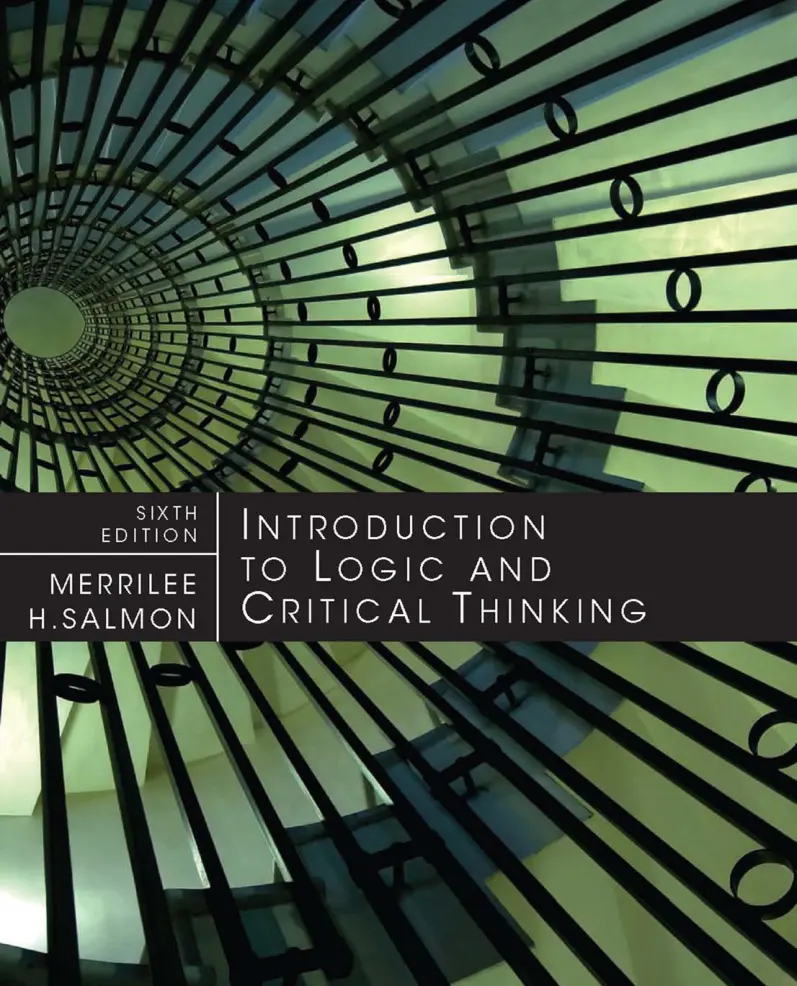
Introduction to Logic and Critical Thinking Book Summary & Review
Quick Summary
A premier foundational textbook that guides students through formal symbolic deductive logic, inductive probability, and everyday rhetorical fallacies.
Book Topic and Premise
In an era saturated with contradictory media narratives and deceptive advertising, how do we distinguish a structurally sound argument from emotional manipulation? Merrilee H. Salmon addresses this vital modern dilemma in Introduction to Logic and Critical Thinking by providing a rigorous, mathematical look at language construction. The textbook teaches readers that clear thinking is not an innate talent, but a skill that requires structured training.
Navigating this academic PDF version exposes students to clear truth tables, Venn diagrams, and symbolic derivation models. Salmon expertly balances the cold mechanics of formal deductive logic with the practical demands of daily communication. The text shines when it breaks down informal fallacies, showing how politicians use strawmen and red herrings to distract from weak premises.
Throughout the chapters, the mechanics of inductive reasoning and statistical probability are thoroughly explained. Reading these logical proofs equips you to evaluate scientific claims and legal arguments objectively. It stands as a profound, highly educational story of analytical reasoning, urging us to question assumptions and demand clear evidence before accepting assertions as absolute truths.
Detailed Plot & Summary
Merrilee H. Salmon delivers a balanced introduction to both formal and informal logic. The text outlines how to properly structure arguments, separate premises from conclusions, and identify structural flaws. Salmon splits the curriculum into deductive logic—covering truth tables and symbolic proofs—and inductive logic, which looks at scientific hypotheses, statistical probabilities, and causal reasoning. Everyday examples from advertising, politics, and legal briefs are dismantled to show how easily language can be manipulated.
✍️ Editor’s Note: A timeless pedagogical work. It is exceptionally well-suited for preparing students for analytical exams like the LSAT or GRE.
Critical Review and Analysis
Salmon’s clarity in explaining symbolic derivations is highly commendable. The step-by-step introduction of truth tables makes logic accessible to humanities students. However, the end-of-chapter homework exercises do not include an integrated answer key in standard print editions, making self-guided study difficult.
Main Themes & Motifs
- Deductive Validity
- Statistical Induction
- Rhetorical Fallacies
- Symbolic Notation
Who Should Read This Book?
Philosophy students, pre-law students preparing for the LSAT, data scientists, and anyone looking to improve their debate skills.
Why You Should Read It
It sharpens your mind to instantly detect flaws in logic during debates, workplace negotiations, and media consumption.
Key Takeaways & What You Will Learn
The ability to map arguments using symbolic variables, calculate basic inductive probabilities, and dismantle manipulative logical fallacies.
Technical & Bibliographic Details
| 📖 Title: | Introduction to Logic and Critical Thinking |
| 🔍 Original Title: | Introduction to Logic and Critical Thinking |
| ✍️ Author: | Merrilee H. Salmon |
| 🗣️ Translator: | None |
| 🏢 Publisher: | Cengage Learning |
| 📅 Publication Year: | 2012 |
| ⏳ First Published: | 1984 |
| 🔢 ISBN: | 9781133049753 |
| 📦 Amazon ASIN: | B00B6E963C |
| 📄 Total Pages: | 416 |
| 📁 Category: | Philosophy, Logic, Education, Mathematics, English |
| 🌍 Language: | English |
| ⭐ Goodreads Rating: | 3.85 / 5.0 (64 votes) |
| ⏱️ Reading Time: | 9 hours |
| 📊 Difficulty Level: | High |
| ⛓️ Book Series: | None (Vol. None) |
| 🏆 Awards: | Standard Text Selection across global philosophy faculties |
| 📚 Similar Books: | A Concise Introduction to Logic, Critical Thinking: An Introduction |
| ✍️ Other Books by Author: | Philosophy of Science, An Introduction to the Philosophy of Science |
⚠️ Content Warnings: None
Frequently Asked Questions (FAQ)
❓ Does Salmon cover formal symbolic logic or just informal debates?
The book covers both, dedicating substantial chapters to symbolic notation, truth tables, and deduction alongside informal fallacy analysis.
❓ Is this text suitable for preparing for the LSAT?
Yes, the analytical reasoning, argument structure mapping, and deductive logic sections align perfectly with LSAT logical reasoning questions.
❓ What is the difference between induction and deduction as explained here?
Deduction guarantees the truth of a conclusion if the premises are true, whereas induction establishes a conclusion based on probability and patterns.
❓ Are there real-world advertising examples analyzed?
Yes, Salmon pulls real examples from historical political campaigns, print ads, and legal trials to show logic in action.
❓ Which edition is this specific manual based on?
This is based on the 6th edition, which includes streamlined chapters and updated contemporary argumentation examples.
❓ Can a student learn logic from this book without an instructor?
While the explanations are crystal clear, the advanced symbolic proofs can be quite challenging without an external lecture or answer guide.
📚 Recommended Category: Explore more in our Philosophy hub.